
Shop settings
Your address and time zone, the working week and holidays, your logo, and the shop-wide defaults everything else is measured against.
The quietest screen in the app and the one with the longest reach. Signing up asked for your shop name and nothing else, so this is where the rest of the shop gets described: where it is, what days it works, what it puts on a purchase order, and where the limits are on spending. Every date on every Gantt in the shop is computed against what is set here.
Find it at Shop, then the Settings tab. It is also step 1 of the dashboard setup checklist.
Branding
Your logo, printed on the documents Jeevy generates: quotes, purchase orders, quote requests and work orders. Without one, those documents carry your shop name and nothing else.
PNG or JPG, up to 5MB. SVG is not accepted, because the logo is rendered into PDFs on the server.
Shop location and time zone
Location is a Google-backed address box. Start typing and pick the place from the list; picking one resolves the printable address and the time zone in the same step. If Google is unreachable or the place is not in its list, there is no dropdown and whatever you typed is saved as written, so the field never refuses an address.
Time zone is an editable select sitting under it, not a read-only line. Picking an address fills it in. Picking here overrides that.
Press Save location. The address and the time zone save together.
Working calendar
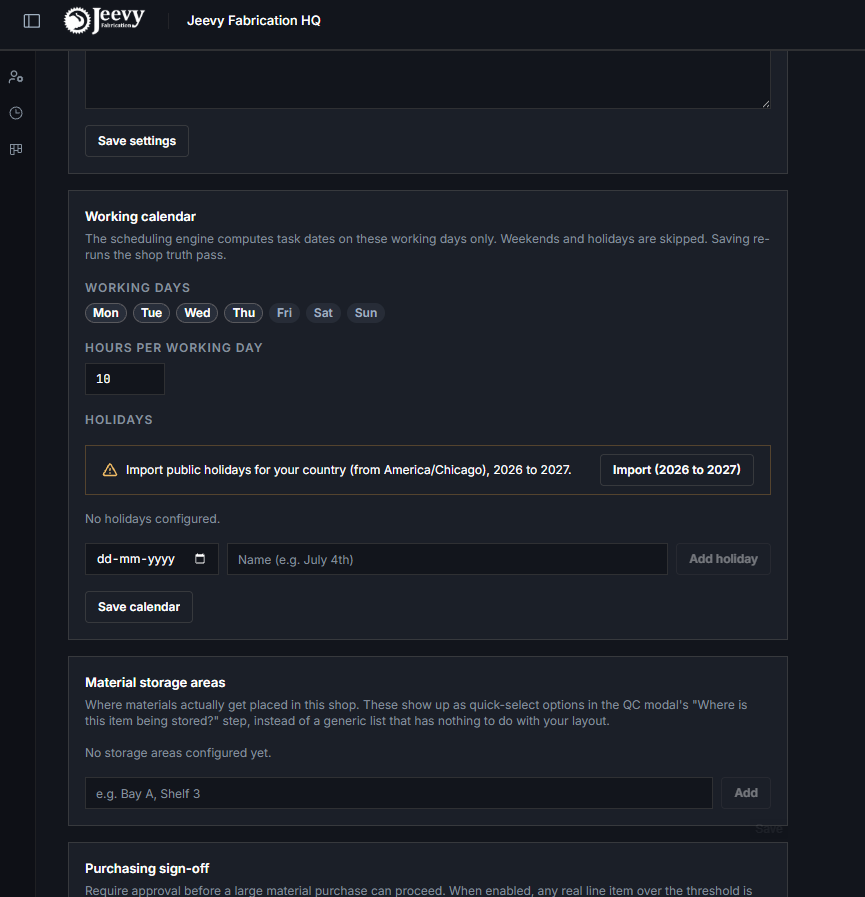
Working days and hours per day are what every task duration is laid across. A three-day task in a Monday-to-Thursday shop does not finish in three calendar days, and the schedule knows that because of this screen.
- Working days are the seven day chips. Tap to turn a day on or off.
- Hours per working day is a single number for the shop, in half-hour steps.
- Holidays are a dated list, grouped by year. Import pulls the public holidays for your country, derived from the shop time zone, for this year and next. You can add one by hand, and remove a year's imported set in one action.
Hours per day, not hours per person
The shop day is what a double booking is measured against. Twelve hours of work assigned to one person against a ten-hour day is a conflict; the same twelve hours in a twelve-hour shop is not.
Changing this changes what counts as over-committed across every open job. See Conflicts.
The rest of the panel
Four more cards sit below the calendar. They are shop-wide defaults rather than schedule inputs, so they are easy to miss and expensive to leave wrong.
| Card | What it sets | Who can change it |
|---|---|---|
| Quote defaults | Standard terms and conditions copied into each new quote bid. Editing them here does not touch bids that already exist. | Anyone with shop management write access |
| Material storage areas | The places materials actually get put in your shop. They become the quick-select options in the QC modal's "Where is this item being stored?" step. | Anyone with shop management write access |
| Email audit instructions | Plain-language standing instructions for the daily inbox agent, used alongside its own PO and RFQ detection. See The inbox agent. | Owner or Manager |
| Purchasing sign-off | Require approval above a dollar threshold. Any real line over it routes to Needs Approval instead of going straight to On Order or Purchased. | Owner or Manager |
| Vendor credit line | Block purchases on vendor credit that exceed the vendor's remaining credit, or where no credit line is set. See Vendors and accounts payable. | Owner only |
When a change takes effect
Saving the working calendar re-runs the shop truth pass: the schedule recomputes automatically after a change to working days, hours or holidays. You do not have to go and re-run anything.